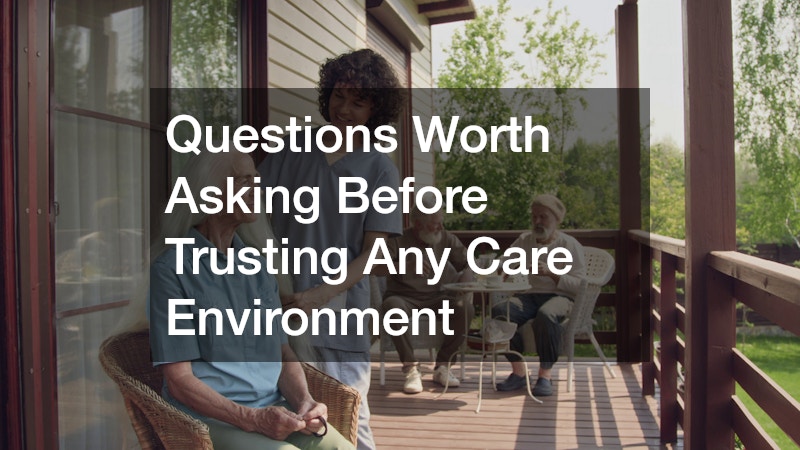
Choosing a care environment — for a child, an aging parent, or a family member with special needs — is one of the most consequential decisions a person makes. The stakes are high precisely because the setting becomes part of someone’s daily life, shaping their safety, dignity, and well-being. Yet most people enter the process without a clear framework for evaluation. They tour a facility, meet a friendly staff member, and sign paperwork within days.
This article lays out the questions that actually matter, and explains why asking them — and listening carefully to the answers — makes a measurable difference.
What Credentials and Compliance Records Actually Tell You
Licensing is the floor, not the ceiling. Every legitimate care environment must hold current state licensure, but a license confirms only that a facility met minimum standards at the time of inspection — not that it has maintained them. The more useful question is: what does the inspection history look like?
State licensing agencies publish inspection reports and deficiency records for most regulated care settings. Reviewing the past three years of inspection outcomes reveals patterns that a single tour never will. One minor deficiency in three years is a very different story from repeated citations for the same issue — medication administration errors, unannounced staff-to-resident ratio violations, or documentation failures.
Ask directly:
- Request the two most recent state inspection reports in writing, not just a verbal summary, and look specifically for repeat citations in the same category across consecutive years.
- Confirm whether the facility has faced any corrective action plans within the past 24 months, and ask what changes were implemented as a result.
- Verify staff-to-resident ratios during night shifts and weekends, since those windows are where licensing minimums are most commonly stretched.
Credentialing extends to individual staff as well. Care aides, nurses, and therapists should hold verifiable certifications in their discipline, and background check policies should be clearly documented. Facilities that hesitate to explain their hiring and credentialing process are telling you something important.
Transparency in Daily Operations and Communication
A care environment’s real culture is visible in how it handles conflict, communication, and the ordinary friction of daily life — not in how it presents during a scheduled tour. The right questions here are less about policy documents and more about lived behavior.
Ask what happens when a resident or family member raises a concern. A well-run environment has a defined grievance process, a named person responsible for follow-up, and a track record of documenting and closing complaints. Vague assurances like “we have an open-door policy” are not answers. Specific processes are.
Transition from tour mode to operational mode by requesting to speak with current residents or their family members without staff present. Most quality environments will accommodate this without hesitation. Reluctance to allow unsupervised conversations is a significant warning sign, regardless of how polished the facility appears on the surface.
Communication norms vary widely. Some environments send weekly updates to family members; others contact families only when a significant incident occurs. Neither model is universally wrong, but the facility’s communication frequency and format should match what the family actually needs. A family member managing care from a distance who receives only quarterly updates is likely to miss early warning signs of decline or dissatisfaction.
Evaluating Staffing Stability and Care Continuity
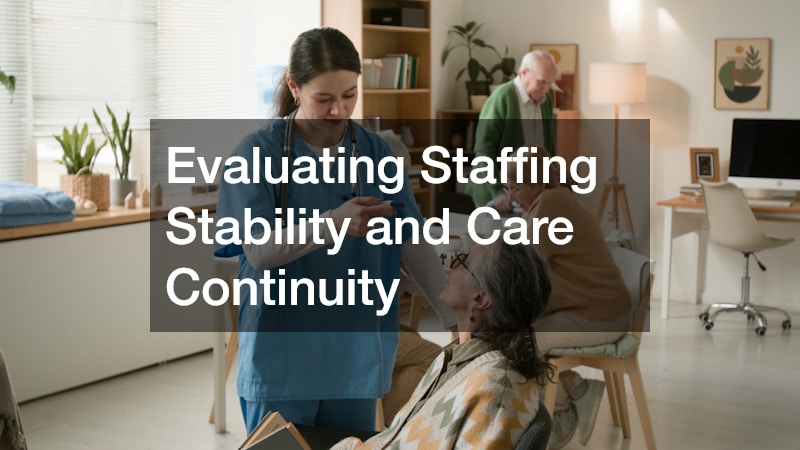
High staff turnover is one of the most reliable predictors of care quality problems — and one of the easiest figures to obscure during a sales tour. Turnover affects medication continuity, relationship-based care, and the ability of staff to detect subtle changes in a resident’s condition. In care environments for older adults, those changes can be clinically meaningful within a matter of days.
Ask specifically about annual staff turnover rates for direct care workers. Industry data consistently shows that high-quality environments maintain turnover rates well below the sector average, which in many care settings runs above 60% annually. A facility that cannot or will not answer this question directly deserves follow-up pressure.
The comparison that matters most here is between facilities that staff primarily with agency or contract workers versus those that rely on long-term employees. Agency-heavy staffing can cover gaps in headcount but comes at the cost of continuity — residents encounter unfamiliar faces regularly, care plans are less reliably followed, and behavioral or health changes are harder to catch. This tradeoff is particularly consequential in memory care units, where consistent relationships are not a comfort bonus but a functional care requirement.
Senior living facilities have faced significant scrutiny on staffing ratios in recent years, with several states tightening minimum-hours requirements for direct care workers. Understanding where a given facility stands relative to both state minimums and nationally recommended benchmarks provides meaningful context that promotional materials rarely supply.
Assessing Physical Environment and Emergency Preparedness
The physical setting of a care environment affects safety in ways that are easy to overlook during a polished tour. Design elements that seem minor — the width of hallways, the brightness of lighting in communal spaces, the accessibility of outdoor areas — have measurable effects on fall rates, social engagement, and resident autonomy.
Walk the space at a different time than the scheduled tour. Request a visit during a meal service or an activity period to observe how the environment actually functions under normal operational load. A dining room that seats 80 residents served by three staff members tells a different story than the ratio described in a brochure.
Emergency preparedness is a category most families never ask about until something goes wrong. Key questions include:
- Confirm that the facility holds current written emergency response plans for fire, severe weather, and extended power outages, and ask when the plan was last tested with staff — not just reviewed on paper.
- Ask whether the building has a backup generator capable of sustaining medical equipment, climate control, and communication systems for at least 72 hours without external power.
- Request the incident log for the past 12 months and note whether emergency-related incidents are documented with outcome data — meaning what happened after the event, not just that it occurred.
Facilities that treat emergency preparedness as a compliance checkbox rather than an operational priority tend to show that attitude in how they answer these questions. Specific, confident answers indicate genuine preparedness; deflection or generalities indicate the opposite.
Making the Decision With Eyes Open
No care environment is without flaws. The goal of this evaluation process is not to find a perfect facility — it is to distinguish between environments where problems are identified, addressed, and communicated versus environments where they are minimized or hidden. A facility that openly walks you through a past inspection citation and explains the corrective steps taken has demonstrated more accountability than one with a spotless presentation and no visible record.
Document every answer you receive. Bring a written list of questions to every visit and note the responses in real time. Comparing answers across multiple facilities is far more instructive than relying on memory or impressions. Decisions made under emotional pressure or time constraints tend to prioritize surface-level appeal over the structural factors that determine long-term care quality.